




Media Contact
Related News
Related News






Hillary Omoregbe works in NSW Health Pathology’s Statewide Sequencing Service Laboratory at Prince of Wales Hospital, Randwick, where she plays a key role in germline exome and gene panel sequencing data generation.
She is also part NSW Health Pathology’s somatic variant curation team for the Precision Oncology Screening Program enabling Clinical Trials initiative – PrOSPeCT.
Hillary says she’s proud to contribute directly to the diagnosis of patients across a broad range of genetic conditions, including rare and complex cancers.
Starting a career in genomics
After moving to Sydney from Nigeria in 2012, Hillary began studying a Diploma of Laboratory Technology at Ultimo TAFE, where she was awarded the DHM prize for highest aggregate score at graduation. She then went on to complete a Bachelor of Biomedical Science at the University of Technology, Sydney.
Hillary first connection with NSW Health Pathology came through a six-week placement at our St George Hospital laboratory, as part of her course requirements (Professional Experience in Biomedical Science).
“I really enjoyed that. I rotated through the chemistry, microbiology, haematology labs, and spent a little bit of time in anatomical pathology and I realised this was exactly what I wanted to do,” she said.
After the placement Hillary was offered an entry role in the cytogenetics lab at Prince of Wales Hospital in 2017, which allowed her to continue studying.
“I finished my master’s degree while working and the more I learned about genetics, the more I fell in love with the work. I had really good teachers and bosses.”
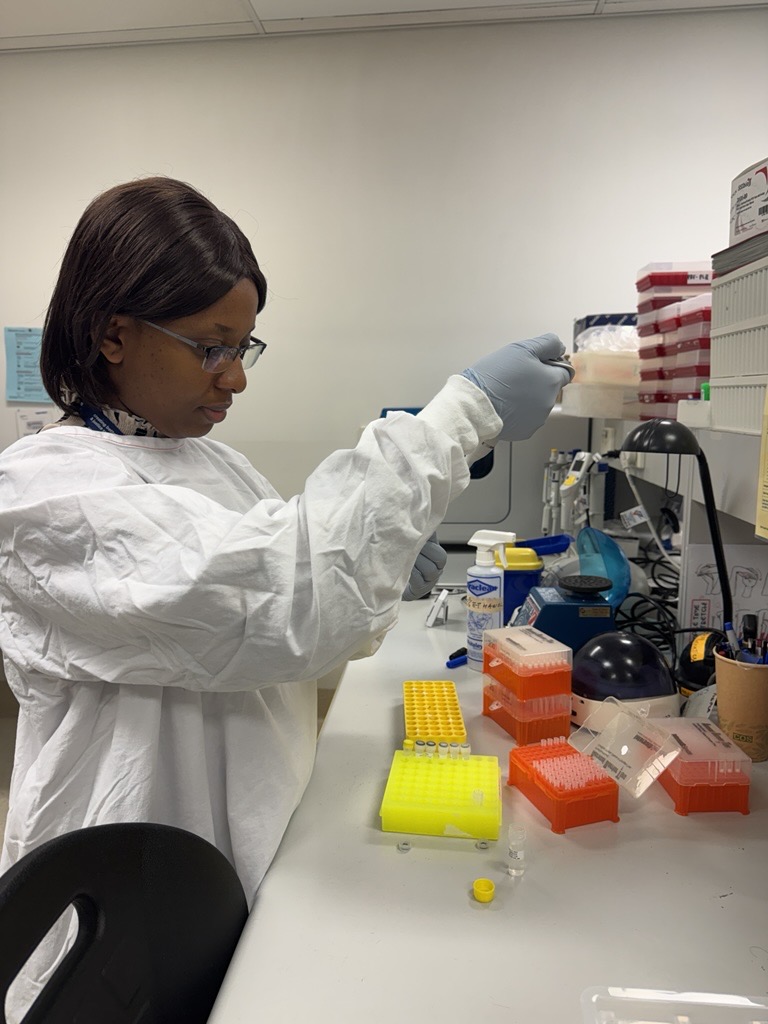
In 2022 Hillary moved into exome and gene panel sequencing.
“My day-to-day work now involves sequencing exomes, which are the protein-coding regions of the genome and although exomes make up only a small portion of the genome (~2%), they contain information that affects how our cells function,” Hillary explained.
“Changes in these regions are more likely to cause disease, and that is why exome sequencing is a very helpful tool for us to diagnose genetic conditions.
“Everyone has about 20,000 genes and changes in these regions can be responsible for a patient’s diseases, so we sequence those areas to help find the variants in the code that may be involved in various conditions.”
A passion for culture and fashion

Outside the genomics lab, Hillary says she has always had a keen interest in fashion and cultural expression.
From dressing up for school events as a student in Nigeria, to wearing striking outfits for her wedding ceremonies held across two continents – fashion has remained a constant source of joy.
Hillary was initially married in Nigeria in 2024 in the stunning dress pictured above. A later ceremony in Sydney in 2025 featured an equally beautiful dress.
She also entered the 2023 Miss Sahara pageant in Sydney, a national beauty pageant that aims to promote leadership growth and raise awareness of Africa’s diverse and rich cultures.
“It’s really more than a beauty pageant,” she explains. “It’s more about empowering and celebrating African-Australian women and showcasing their culture and talents.”
“It was a lot of fun, and I finished as the first runner-up, which was a huge honour!”


“Patient care is always at the heart of what I do”
Hillary says she’s motivated by knowing her work has a direct impact on patient care.
“Some of my work also involves providing DNA profiling for the PrOSPeCT study which is bringing the opportunity for patients to access potentially lifesaving treatment pathways for more than 20,000 Australians with rare, difficult-to-treat or incurable cancers.
“For a lot of these patients, the standard treatments aren’t working, and so this is another chance to find a treatment that may help.
“We are looking for genetic variants that enable patients to be enrolled on clinical trials for novel treatments or approved therapy for a different cancer to see if those same therapies can be used to treat their rare or complex cancers.
“For example, if we see a particular variant in a patient with colorectal cancer, and that same variant has been detected in a breast cancer patient who has responded well to a particular drug, then they may be eligible to be enrolled in a clinical trial to see if colorectal patients benefit from that drug.”
Hillary says the work is challenging but she’s also enjoying the opportunities it brings; including training other scientists and technical staff, making key decisions within the team, professional growth and leadership development.
“My boss here at Randwick, Senior Hospital Scientist Monica, is great and the team is A for amazing!
“That’s part of the reason I think it’s so much fun to come to work every day. It’s a really close-knit team.”
Advances in immunotherapy, genomics, diagnostics, digital health, and AI are continuing to transform the way we prevent, detect, and treat cancer. However, at the heart of our cancer care remains the incredible people who deliver it throughout NSW every day.
Want to know more about how we are working to lessen the impact of cancer? Take a look at the NSW Health Cancer Plan here.